By Amanda Kleintop, Ph.D.
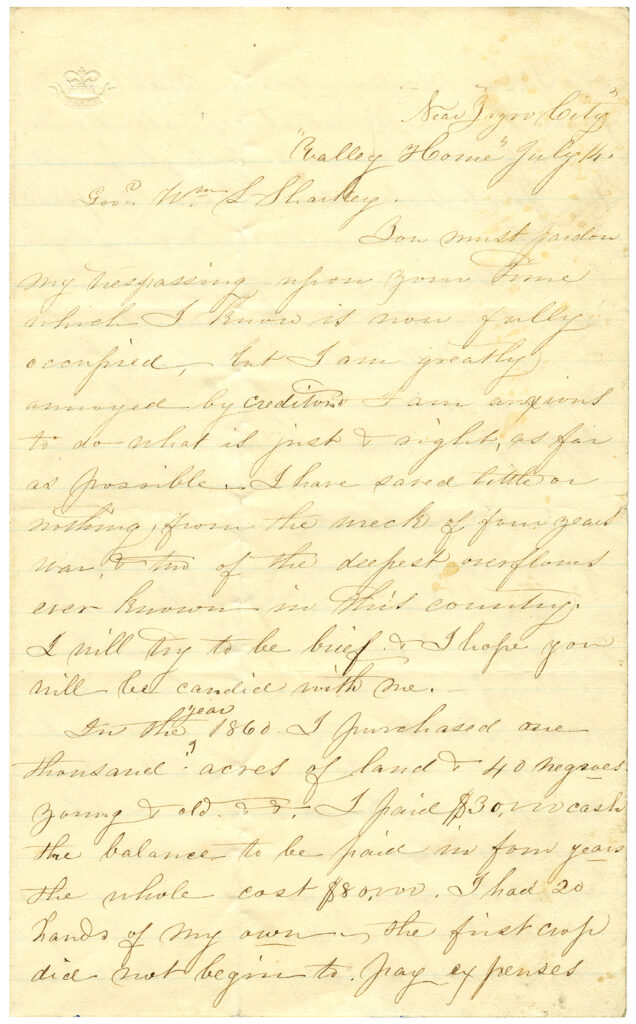
On July 14, 1865, about three months after the Confederacy’s surrender at Appomattox, Nannie Denman wrote to the Governor of Mississippi, William Sharkey, from Valley Home, her plantation near Yazoo City. In 1860, Denman was a planter with $40,000 in real estate and an estimated $66,635 in personal estate. She claimed sixty one enslaved people, including infants and the elderly.[1] A widow, Denman had run her plantation consistently with the business practices of the time. Hers was a large enterprise, but it was built on debt. She had purchased forty people and 1,000 acres of land in 1860 with a mortgage, paying $30,000 up front with $50,000 remaining to be paid over four years. Of course, the war intervened. As the cost of farming expenses rose, she extended the first payment. The war went on and, as she told Sharkey, “you know the sad fate of our country.” She was still indebted, but now she asked: “do you think that I will be compelled to pay for the negroes when they have been a tax upon me”?[2]
Denman’s predicament was typical for widows and former enslavers alike after the Civil War. The U.S. government’s wartime decision to abolish slavery without compensation to former enslavers left many insolvent after the Civil War and diminished the South’s wealth by sixty percent. Certainly, the mortgage system that undergirded the South’s plantation economy did not predict immediate, uncompensated emancipation. Denman explained, “There was a mortgage taken upon the land & negroes,” but, she suggested, “I believe all bills of sale garentees a negro, Slave for life.” She referred to the written or unwritten warranty that usually accompanied the purchase of an enslaved person. However, as long as the seller had fulfilled their part of the bargain by surrendering, in this case, the land and enslaved people whom Denman purchased, the contract for their sale and therefore Denman’s mortgage was also valid. Similar to Denman, many other debtors appealed to the courts for relief, insisting that, by destroying their property rights in people, emancipation invalidated their original contracts for the purchase of an enslaved person.[3]
With the rise of married women’s property laws before the war, slaveholding widows may also have been especially insolvent. States began to shield women and children from their husbands’ or fathers’ indebtedness with new property laws. After a serious financial panic, Mississippi passed the first U.S. married women’s property law in 1839, followed by a number of states in the next decades. Yet, as historian Laura Edwards has argued, married women’s property acts “were not designed with women’s individual interests in mind.” These antebellum legal practices were designed to keep the wealth from human property in the family. Savvy slaveholding families took advantage of married women’s property laws to shield assets, particularly property in people, from seizure in the event that a patriarch defaulted on his debts.[4]
No longer able to leverage the value and bodies of enslaved people against their debts, debtors petitioned their states and the federal government to invalidate contracts for the purchase of enslaved. As I argue in my recent book, Counting the Cost of Freedom (UNC Press, 2025), debtors’ appeals were part of a widespread effort on the part of white southerners to seek compensation or relief from the cost of immediate, uncompensated emancipation. Many insisted that the Constitution, doctrines of property law, principles of fairness, and the need for regional economic stability dictated that they be reimbursed for the loss of the value of the enslaved humans they legally held as property prior to the passage of the Thirteenth Amendment. In addition, widows like Denman and their representatives made unique claims on their states and the federal government revealing that their claims for relief were in fact attempts to stabilize the southern economy by adapting the gendered logics of the slaveholding household.[5]
Denman’s letter to Sharkey demonstrates many of the ways in which widows and politicians claiming to work on their behalf mobilized widows’ unique gendered and legal status to appeal for relief. Sharkey had been appointed governor by President Andrew Johnson to usher the state back into the Union. Formerly a member of the Whig Party, Sharkey opposed secession and remained a Unionist despite living in Mississippi throughout the Civil War. After his appointment, he called a convention to write a new state constitution, where delegated maneuvered to secure federale compensation for freed slaves. But in the summer of 1865, before the ratification of the Thirteenth Amendment, few knew how the federal government would carry out emancipation. Delegate to the convention pushed for policies other than immediate, uncompensated emancipation.
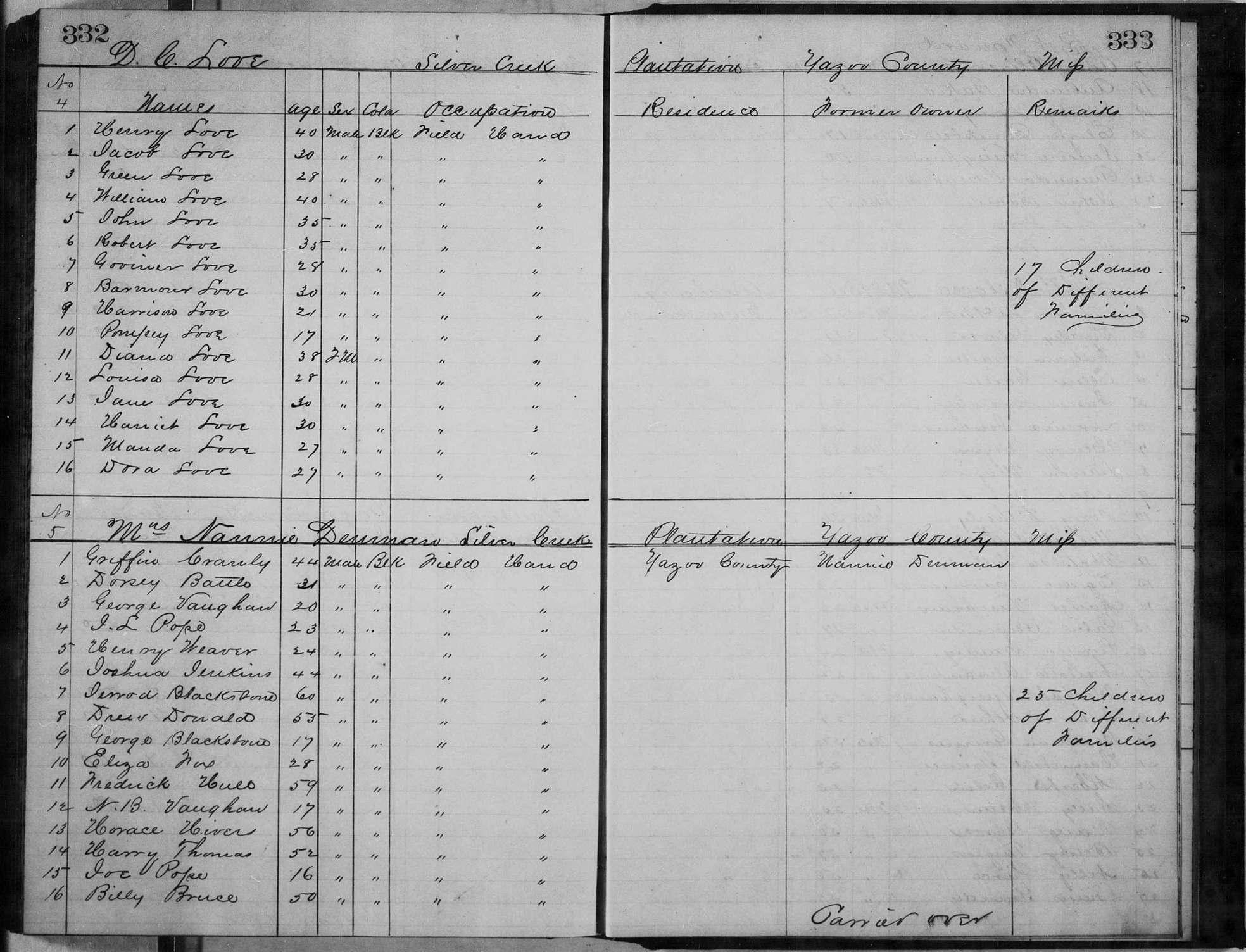
Widows’ unique claims for federal compensation provided a powerful rhetorical tool for proponents of compensation and relief, tying the two different legal issues together. Denman suggested that uncompensated emancipation placed a particular hardship on debtors. She wrote, “If I had paid for the place & negroes I should not care, but to be forced to give up my home & all I had” in the event that she defaulted on her debt “will be too hard.” She emphasized her sound fiscal decisions and capability, telling Sharkey, “I am & have been a widow for 12 years I have lived economically & tried to manage judiciously to make a home for my little family.” As historian Ariela Gross has shown, the law might side with enslavers, particularly men, if they could demonstrate their “good business sense” in a legal conflict. This is one reason that Denman stressed that her indebtedness was no fault of her own, but a tragedy of circumstance.[6]
Similarly, Denman attempted to shield herself from any blame for the situation she was now in. She would not be impoverished, she insisted, if it were not for emancipation. In the summer of 1865, when many southern white men were still barred from voting or otherwise participating in formal politics, emphasizing the innocence of widows and other women was a way to dissociate the issues of the war — especially slavery — from the politics of reunion. Widows were dependents like other women and children, but as a result of their widowhood, they were no longer sheltered under the same private household relationships as wives or single women. At the same time, the idea that dependents were nonpartisan, nonpolitical beings, loyal to their patriarch and not to their governments, enabled politicians to claim compensation on behalf of “innocent” widows and orphans, but not other enslavers.[7]
However, as women’s historians of the Civil War era have pointed out, women mobilized the politics of loyalty to their own ends. At the end of her letter, Denman alluded to her cousin, who had recently been appointed the provost marshal of her region. She told Sharkey that “the country is quiet & getting along slowly” because he had “no guard to enforce his orders, so has to use policy.” The report would have tied Denman to a U.S. army officer, emphasizing her loyalty by proxy if not by practice.[8]
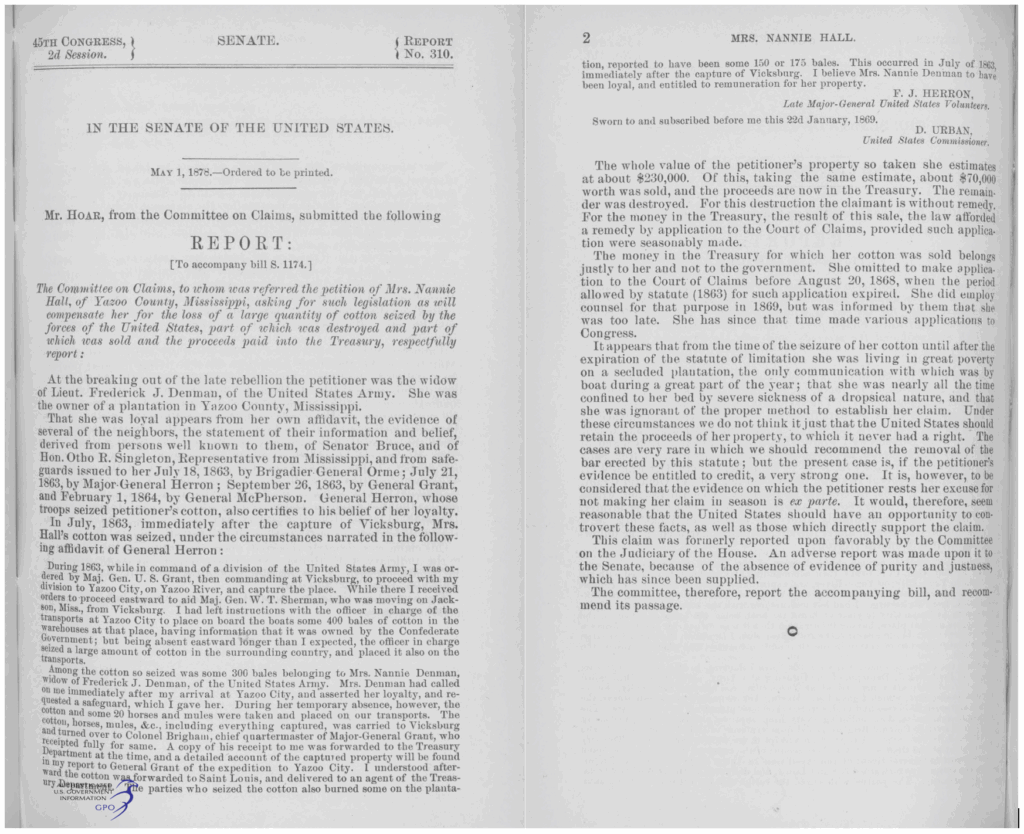
The widow’s appeal also had some basis in nineteenth-century law. Especially in the North, states had enacted wrongful death statutes that made widows, dependent children, and next of kin the exclusive beneficiaries of payments in death actions for their patriarchs. The logic was that upstanding families required income from a male provider. Conversely, widows whose husbands and fathers had once provided for them deserved social support. Courts had also traditionally considered the economic consequences of property confiscation to determine whether someone should receive compensation under the takings clause. Wartime relief programs for war widows, for example, may have consolidated this legal logic in the South. Many Confederate states had sponsored relief programs for widows and families whose patriarchs had joined the army or died in war. Denman’s letter similarly portrayed widows as a protected group to beg relief.[9]
There’s much we don’t know from Denman’s letter alone. Did Sharkey answer? Did Denman sell the land or maintain it, particularly by hiring freed people? Did she agree with those Mississippians who did pursue federal compensation for slaves, as well as debt relief? Nevertheless, it’s clear that these questions about compensation and relief affected the economic reconstruction of the South. As she ended her letter, Denman asked Sharkey for business advice, which would have enhanced her gendered approach by appealing to him as a patriarch and focusing the issue back on her business. “I will greatly depend upon your advice or suggestions the course to persue.” She could “give the place back or hold on if the levees are rebult the land will be as valuable as ever.” I don’t know what advice Sharkey gave her, and it’s difficult to identify her in the 1870 Census. It’s possible that the two young girls who lived with her in 1860 moved to Carroll County sometime before 1870, suggesting that the household did not remain intact.[10]
It’s unlikely that Denman received any relief. When it was ratified in 1868, the Fourteenth Amendment invalidated any claims for compensation for the value of formerly enslaved people. Although many southern states enacted a series of debt relief laws, including debts for the value of slaves, these laws only went so far. After Denman appealed to Sharkey, many southern courts and, eventually, in 1871 the Supreme Court ruled that emancipation was an act of God that did not constitute a broke contract. They did not agree that a public act should affect private contracts. So Denman and others in her predicament were legally bound to pay their debt, but we also do not know whether they did. They may have defaulted, simply unable to pay.[11]
Denman’s letter represents the uncertainty of emancipation policy in the contingent moment of the summer of 1865 and the many legal questions surrounding emancipation that Americans had to confront in Reconstruction. Denman may have been able to maintain her plantation with a different form of labor and eventually pay her debts for slaves, but that possibility was riskier in a world without the antebellum guarantees of slave mortgages and credit valued with property in people. Facing financial instability and new social realities, slaveholding widows and their political allies wielded their local influence and understanding of antebellum law and financial practices to claim the right to relief from the costs of emancipation.
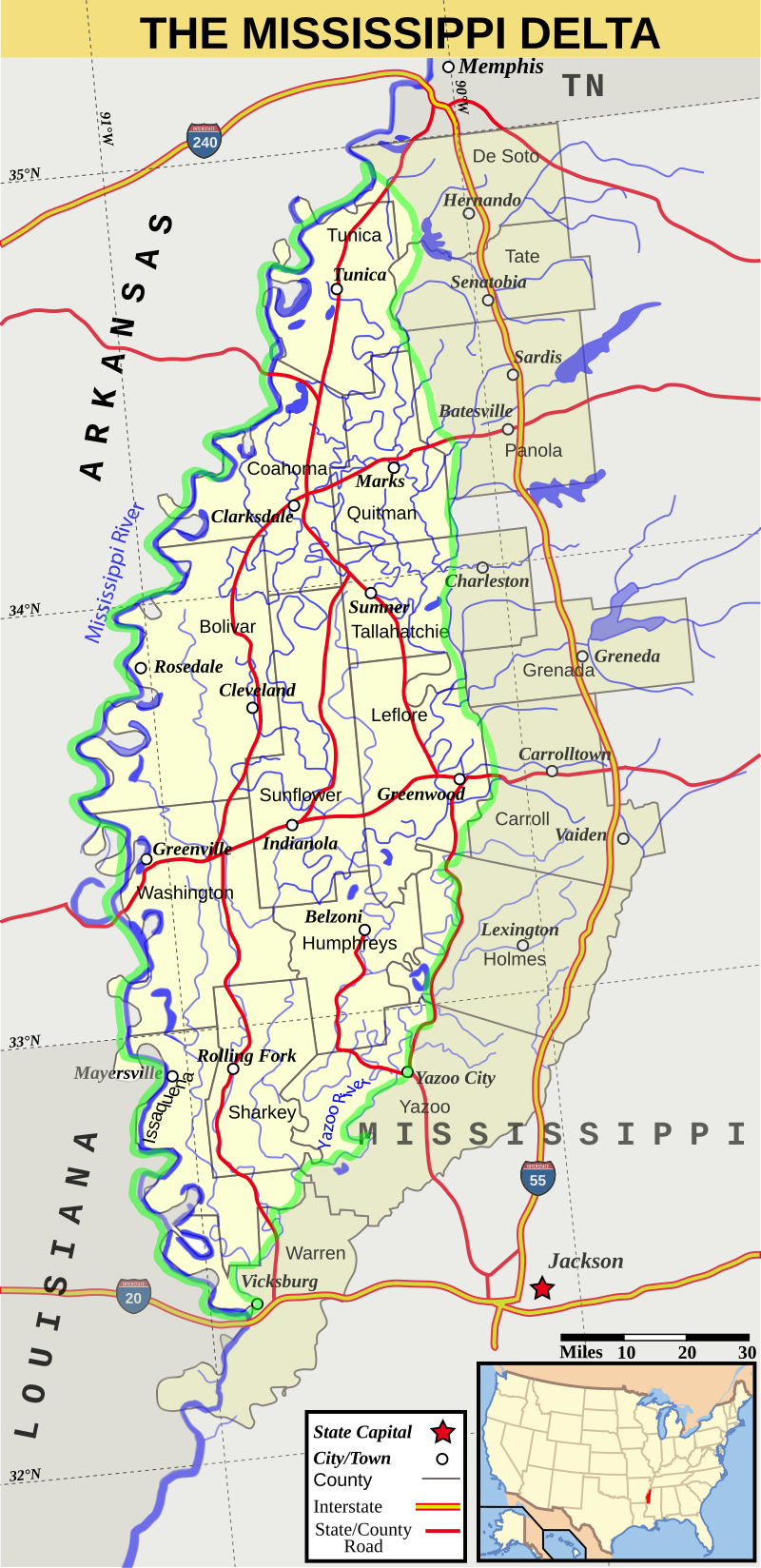
That said, those costs were not evenly distributed. Denman’s Valley Home plantation was near Yazoo City, possibly in Holmes County and near one of the poorest communities in the U.S. today. The area is situated at the southeastern edge of the Mississippi Delta and part of the Black Belt where African Americans were forced into coercive labor conditions and disenfranchised by Jim Crow. Thanks to these practices, most southern families who had claimed enslaved people invented new forms of coerced labor and plunder to recoup their financial losses from emancipation within one generation.[12] Whether Denman was among those planters is a new research question, inspired by the GWRGM project.
Amanda Laury Kleintop is an assistant professor of History at Elon University. She received her Ph.D. from Northwestern University in 2018. Her first book, Counting the Cost of Freedom: The Fight for Compensated Emancipation after the Civil War, was published by the University of North Carolina Press in 2025. Her work has been supported by the National Endowment for the Humanities, the American Historical Association, and more.
[1] 1860 Federal Census, Mississippi Yazoo, Dwelling 281; Slave Schedules.
[2] Nannie Denman, “Letter from Nannie Denman to Mississippi Governor William L. Sharkey; July 14, 1865,” Mississippi Department of Archives and History, Sharkey Series 771: Box 955, Folder 3 in Civil War & Reconstruction Governors of Mississippi, accessed September 12, 2025, https://cwrgm.org/item/mdah_771-955-03-45.
[3] For more an overview of slave mortgages and the plantation economy, see: Richard Kilbourne, Debt, Investments, Slaves: Credit Relations in East Feliciana Parish, Louisiana, 1825-1885 (Tuscaloosa: The University of Alabama Press, 1995); Bonnie Martin, “Slavery’s Invisible Engine: Mortgaging Human Property,” Journal of Southern History 76, no. 4 (November 2010): 817–866; Bonnie Martin, “Neighbor-to-Neighbor Capitalism: Local Credit Networks and the Mortgaging of Slaves,” in Slavery’s Capitalism: A New History of American Economic Development, edited by Sven Beckert and Seth Rockman (Philadelphia: University of Pennsylvania Press, 2016), 107–121; Justin Simard, “Slavery’s Legalism: Lawyers and the Commercial Routine of Slavery,” Law and History Review 37, no. 2 (2019), 571–603. Letters similar to Denman’s include: Letter from Martha Deery Churchwell to Andrew Johnson, July 17, 1865, in Papers of Andrew Johnson (PAJ), vol. 8, edited by LeRoy P. Graf and Ralph W. Haskins (Knoxville: University of Tennessee Press, 1989), 416; Annie E. Hutchcroft to Andrew Johnson, July 25, 1865, in PAJ, vol. 8, 471; Ann H. Kincheloe to President Andrew Johnson, January 8, 1866, in PAJ, vol. 9 (Knoxville: University of Tennessee Press, 1991), 578.
[4] Laura Edwards, Scarlet Doesn’t Live Here Anymore: Southern Women in the Civil War Era (Urbana and Chicago: University of Illinois Press, 2000), 28–31, quote from 29; Kirsten E. Wood, Masterful Women: Slaveholding Widows from the American Revolution through the Civil War (Chapel Hill: University of North Carolina Press, 2004); Andrew Kull, “The Enforceability after Emancipation of Debts Contracted for the Purchase of Slaves,” Chicago-Kent Law Review (1994), 528; William Calderhead, “How Extensive was the Border State Slave Trade?: A New Look,” Civil War History, 18, no. 1 (March 1972), 47; Kilbourne, Debt, Investments, Slaves, 99–100; Richard H. Chused, “Married Women’s Property Law: Reception of the Early Married Women’s Property Acts by Courts and Legislatures, 1800–1850,” 1398–1400, 1399n207–209; Stephanie E. Jones-Rogers, They Were her Property: White Women a Slave Owners in the American South (New Haven: Yale University Press, 2019), 25–56, 197.
[5] Amanda Laury Kleintop, Counting the Cost of Freedom: The Fight for Compensated Emancipation after the Civil War (University of North Carolina Press, 2025), 4–5, 75–86, 123–125.
[6] Ariela J. Gross, Double Character: Slavery and Mastery in the Antebellum Southern Courtroom(Princeton: Princeton University Press, 2000), 98–99, 120.
[7] Gregory P. Downs, Declarations of Dependence: The Long Reconstruction of Popular Politics in the South, 1861–1908 (Chapel Hill: University of North Caroline Press, 2011), 4.
[8] Edwards, Scarlett Doesn’t Live Here Anymore, 66–70, 71–84, 97–99; Stephanie McCurry, Women’s War: Fighting and Surviving the American Civil War (Cambridge, MA: Harvard University Press, 2019), 35–54; John Fabian Witt, Lincoln’s Code: The Laws of War in American History (New York: Free Press, 2012); Instructions for the Government of Armies of the United States in the Field (Lieber Code), articles 155–157.
[9] Erwin Chemerinsky, Constitutional Law: Principles and Policies (New York: Wolters Kluwer, 2015), 663; John Fabian Witt, “From Loss of Services to Loss of Support: The Wrongful Death Statutes, the Origins of Modern Tort Law, and the Making of the Nineteenth-Century Family” Law & Social Inquiry 25, no. 3 (2000), 736–7, 744; John Fabian Witt, “Toward a New History of American Accident Law: Classical Tort Law and the Cooperative First-Party Insurance Movement” Harvard Law Review 114, no. 3 (2001), 690–841; Edwards, Scarlet Doesn’t Live Here Anymore, 91–92, 120–121; Gross, “’And for the Widow and Orphan’: Confederate Widows, Poverty, and Public Assistance,” in Inside the Confederate Nation: Essays in Honor of Emory M. Thomas, edited by Leslie J. Gordon and John C. Inscoe (Baton Rouge: Louisiana State University Press, 2005), 217–223.
[10] 1870 Federal Census, Mississippi, Carroll County, Township 20 Range 6, Households 85 and 86.
[11] For more studies on courts’ decisions, see: Giuliana Perrone, Nothing More Than Freedom: The Failure of Abolition in American Law (Cambridge and New York: Cambridge University Press, 2023); Aviam Soifer, “Status, Contract, and Promises Unkept,” The Yale Law Journal 1916–1959; Edwards, The People and Their Peace; Kull, “The Enforceability after Emancipation of Debts Contracted for the Purchase of Slaves,” 493–538; Diane J. Klein, Naming and Framing the “Subject” of Antebellum Slave Contracts: Introducing Julia, “A Certain Negro Slave,” “A Man,” Joseph, Eliza, and Albert, Rutgers Race & Law Review 9 (2008), 243–283; John C. Williams, Slave Contracts and the Thirteenth Amendment, Seattle University Law Review (2016), 1009–1029; Kilbourne, Debt, Investments, Slaves, 99.
[12] Ager, Boustan, and Eriksson, “The Intergenerational Effects of a Large Wealth Shock: White Southerners After the Civil War.” The American Economic Review 111.11 (2021), 3767–94.
