By Solomon Miner, University of South Dakota
While completing my bachelor’s degree in English at the University of South Dakota, I worked as an intern for the Civil War & Reconstruction Governors of Mississippi project (CWRGM) on the Annotation Research Team. As a digital scholarly edition, CWRGM provides brief biographies of the people named in its collection to help users understand the positionality and historical context of the information contained in the archival document. This work typically requires identifying a person’s entire name, birth and death dates, their military service, and other biographical details through researching in digitized historical newspapers, state and federal census records, and military service and pension files. I began my work for the project with little knowledge of how to find or compile accurate historical information about the people mentioned in CWRGM’s collection, but I left with the ability to do just that.
As someone with a specialization in English and creative writing, I was unfamiliar with many of the databases used for research of this kind, like Ancestry.com and FindaGrave, which typically support historical and genealogical research. Unlike the academic journals and book chapters I was used to researching in, these are large, digitized collections of primary sources. Consequently, the time it took for me to complete the research and writing portions for my first assignment, a short biography of a man named Milton Edgar Bacon, was about nine hours. But by the end of the semester, my work was far more efficient and accurate. The latest two people I’ve annotated, Joshua Bourne and Enoch Bennett, required a little over three hours each to fully research and write biographies, thanks to my increased understanding of how to research biographical information and compile it for users.
For this internship, my main task was to use online historical databases to collect accurate biographical information, so I could write brief biographies for people named inside the CWRGM collection. Considering the nature of nineteenth-century archival collections, this task is more challenging than it first seems. I would begin by looking up the name listed in a CWRGM letter—which was sometimes incomplete—in databases like Ancestry, the Library of Congress, Genealogy Bank, FindaGrave, Google Maps, and more. I would branch out from there by looking for information matching not only the subjects’ names, but I also used things like their ages, counties of residence, and occupations to help narrow my search. Researching people with more common names, like George or Smith, was rather difficult because they would generate search results for numerous people with the same name living in the same area.
To identify the correct person, I relied on the context clues found within the CWRGM documents and the digital databases:
- One good marker that I used for all my searches was birth and death dates, which I could typically find from sites like FindaGrave or Ancestry. Using ages found in census records, I determined when people were born. Many nineteenth-century Americans didn’t know the exact year they were born, so records commonly fluctuated by a few years. Then, I could use age as a verification guide.
- Most people died in the county or nearby counties where they were born and lived, so I could also match the counties referenced in cemeteries and census data to the locations mentioned in the CWRGM collection.
These methods helped me verify whether the people I found in databases were, in fact, the correct people I was searching for from the CWRGM collection.
Consider this example from E. R. Bennett, who was mentioned in six CWRGM documents. Based on the already transcribed documents from CWRGM, I could gather that the E. R. Bennett I was searching for was a Confederate veteran who had survived the war. I initially searched for any E. R. Bennett who had lived in Mississippi around 1860, and found a promising result on FindaGrave that ultimately led me down the wrong path.
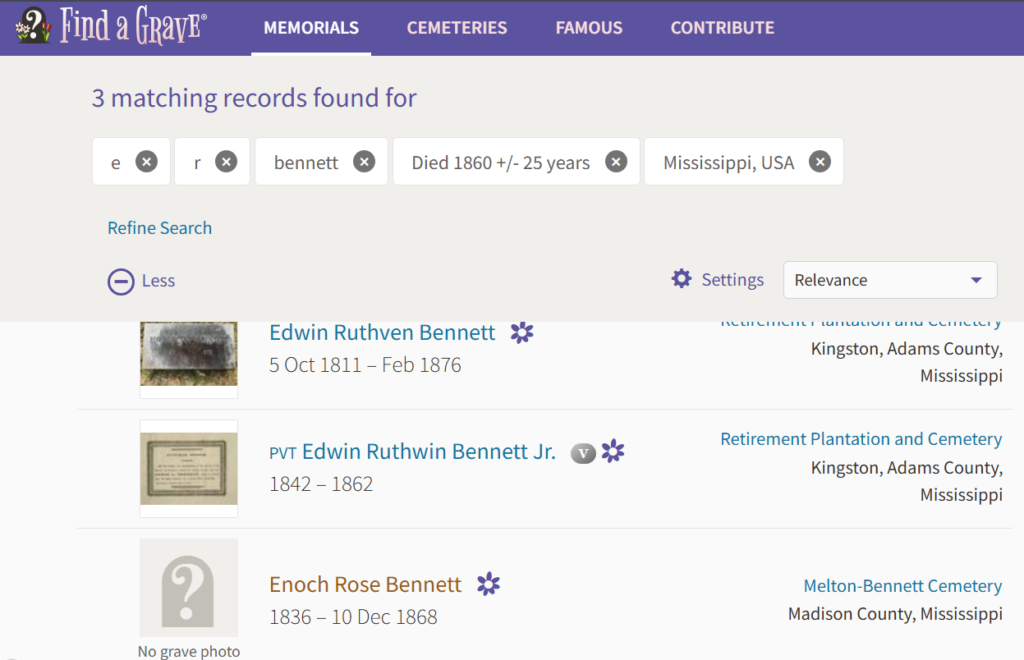
Screen capture of search results from FindaGrave for E. R. Bennett
The search only generated a few results for an E. R. Bennett in the area, and considering that CWRGM’s letters mentioning him were written between 1860 and 1863, I assumed that the Bennett I was looking for was in my search results. Three people appeared: Edwin Ruthven Bennett, Sr., Edwin Ruthven Bennett, Jr., and Enoch R. Bennett. I instantly dismissed Edwin Jr. from consideration because he had died before 1863. The headstone for Edwin Ruthven Bennett was promising and included an accompanying headstone application, which identified him as a veteran of the 10th Mississippi Infantry Regiment, Company B. However, the Ancestry headstone application page also listed his death date as 1862, but the original digitized source listed it as 1872. It was an important reminder to always verify the information transcribed on the website against the original digitized document, as the headstone transcriptions were also incorrect.
The location details then helped me identify which E. R. Bennett was the correct one. Thanks to the CWRGM resources, I know that the Bennett I was searching for had lived in Simpson County sometime around 1860. Edwin Ruthven Bennett was buried in Adams County, and his military service record lists Natchez as his enlistment location, neither of which is near Simpson County. Searching through the 1860 U.S. federal census, I discovered that Enoch Bennett had lived in Simpson County, but Edwin Bennett had not.
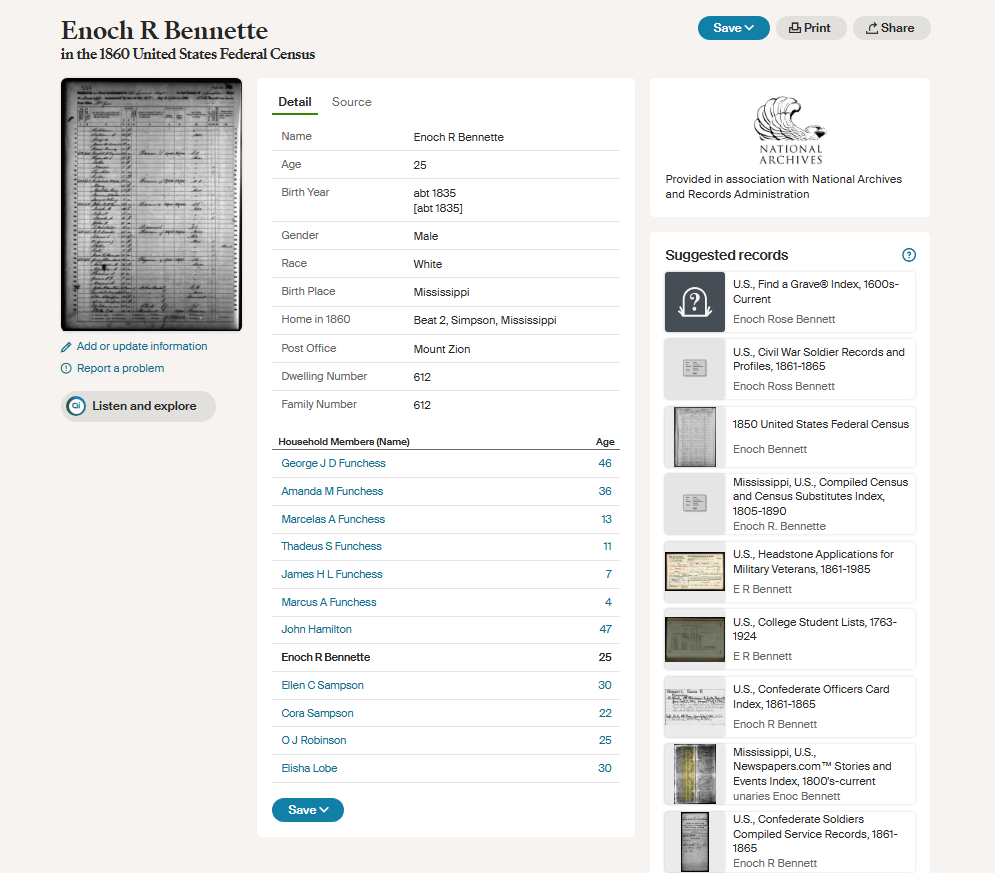
Screen capture of Enoch R. Bennette’s 1860 United States Federal Census page on Ancestry.com
From there, I searched for Enoch Bennett on Ancestry and could not identify him in any census after 1860, which aligns with the suspected death year of 1863. After sleuthing through the records, I had finally identified the correct person.
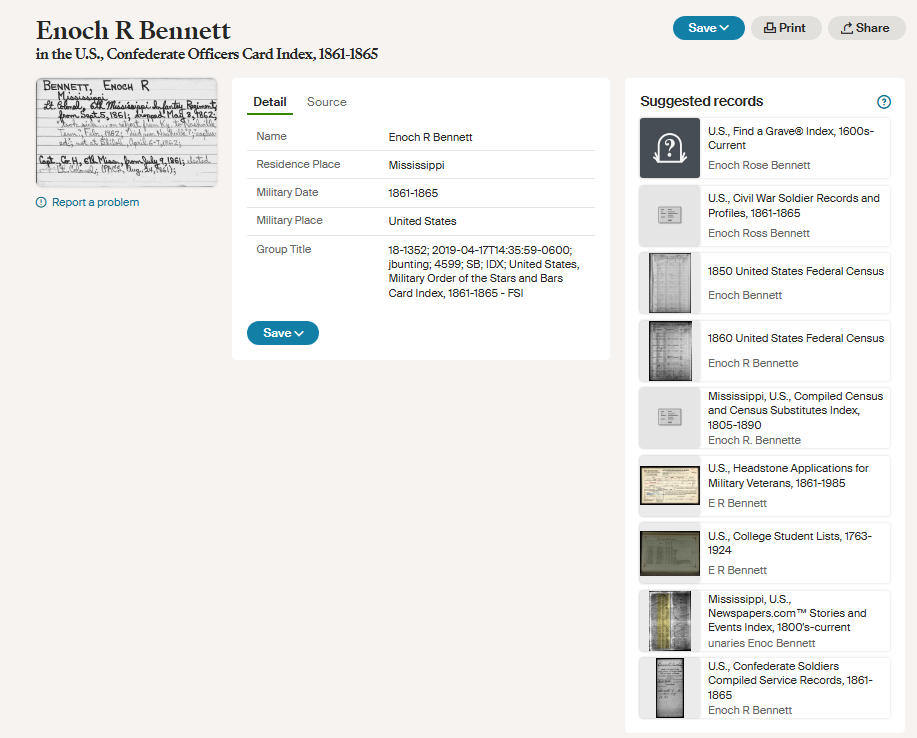
Screen capture of Enoch R. Bennett’s Confederate Officers Card Index page on Ancestry.com.
From my internship with CWRGM, my ability to read cursive and edit historical texts has improved. CWRGM editors utilize FromThePage, a transcription software, where researchers draft, edit, and format document transcriptions. Reading the original documents and comparing them to cursive letters, I began to understand and see previous errors in the transcriptions. I used the new information I had gathered from my annotation research to improve these transcripts by editing several transcribed names and updating subject tags from the People category. My ability to read cursive is poor, which is why I was happy to work on other aspects of the project when given the opportunity, but it has improved, thanks to the countless original documents and records I used to research annotations.
My work on CWRGM was also adjacent to my degree in English and meaningful to me personally. Now more than ever, CWRGM’s collection seems especially historically relevant. Today, we’ve seen a noticeable increase in white supremacist beliefs throughout our nation’s government, reminiscent of those beliefs that brought about the American Civil War and the end of Reconstruction. Learning and researching about Reconstruction and life in the South after the war was interesting and something that I had not previously encountered in academia or sought out personally. As a writer, story research is also critical because it helps to ground the narrative. The type of research I did over the course of the semester while interning with CWRGM also helped me appreciate and understand the work that supports literary and documentary editions. The research skills I learned here will improve the quality and accuracy of any future writing I pursue that features real people, places, or events. The internet contains a wide net of historical information, and it was an interesting, relevant, and powerful experience to comb through these different repositories to find pieces of historical information that were almost entirely forgotten. Piecing the past together one bit at a time is something that I have a lot of respect for, and in my opinion, this project is an invaluable resource for the preservation of history.
My internship on the CWRGM Annotation Research Team also helped me to better understand myself and what I want in a career after graduation. Although I initially found the lack of clearly defined project deadlines and benchmarks hard to adjust to, the ability to take multiple weeks researching a person’s biography to the best of my ability was important. Throughout the internship, I could choose when I would complete my required hours, which I soon found to be liberating. As someone trying to check off boxes for graduation, being able to take a step back and become enveloped in the research was a nice change of pace. This internship opened my eyes to what I can pursue in terms of a career and the possibilities that being a professional researcher might entail. I wish I had known that this internship and research opportunities like it were available to students before my last year here at the University of South Dakota, because I found the experience interesting, academically engaging, and would recommend it to others.
